HOCKEY 101: Training Drills
Learn to Light the Lamp
by Greg Sills
Five Fundamentals to become a Goal-Scroing Luminary
Scoring a goal--or lighting the lamp, as it is sometimes referred to--is the ultimate offensive play and the objective of almost every roller hockey player (sorry goalies). No game can be won unless your team puts the puck into the net more times than your opponent. The good thing about scoring is that it can be developed by practicing specific shooting and scoring drills. To recognize opportunities is one thing, but to consistently capitalize on those opportunities takes practice, and plenty of it! You will score more goals by working on and improving the five principles of shooting--shot accuracy, release location, shot selection, release quickness, and shot speed.
Shooting Accuracy
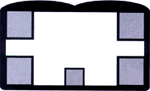 A quick snap shot is worthless unless it is directed at the net. That's why a good coach always reminds his or her players to shoot the puck (at the net). The puck must be on target to have any chance of scoring. But great scorers do more than just shoot the puck in the direction of the goal. Great shooters pick their spots. They aim at the holes the goaltender leaves open while positioned in the crease. Normally, these holes are found in five areas of the net: the top right and left corners, bottom right and left corners, and between the legs of the goaltender (also known as the five hole).
To control the accuracy of the puck, you need to focus on two factors--your eyes and your follow-through with the stick. When approaching the net for a shot on goal, you should keep your eyes on the net to find an opening, then direct your shot using an effective follow-through. In some cases, a quick glance downward at the puck may be required to ensure that the puck is on your stick blade, but this extra step can be reduced and eliminated with practice. It doesn't matter from what distance or angle a puck is shot, accuracy improves when watching your target rather than looking at the puck and stick at the moment of the shot.
Three methods can be used to develop shooting accuracy. (1) A portable goaltender or target system can be used without an actual goaltender in the net. A portable goaltender is a product that partially covers the opening of the net. It has openings in the four corners and the five hole. Use the portable goaltender to train a shooter to shoot the puck consistently (and accurately), into the areas of the net that has the most probability of scoring. (2) Shots should be made from different distances and angles, with a goaltender in net, to become familiar with goaltender positioning and the amount of open net area at each location. Note what openings appear on the stick side, the glove side, along the playing surface, in the upper corners, and near the five hole. (3) A combination of the first and second approaches can be used. Use the portable goaltender initially during the practice with a short period of shooting on the actual goaltender to finish off the workout. Applying the accuracy gained during the target practice to an actual goaltender provides a competitive angle along with game-like experience.
Release Location
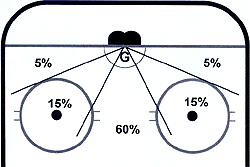 Release location refers to the shooter's positioning with respect to the goaltender and net when a shot is released. Most goals are scored from 5 to 25 feet out, and directly in front of the net (with the majority of those goals coming from between 10 to 15 feet out). That ideal distance changes according to the goaltender's positioning in front of the net, goaltender's skill level, shooter's skill level and shot speed. The ideal time to shoot is when you are far enough away from the goaltender to prevent him from cutting off any open net, but not close enough to give him time to block your shot. Many young hockey players have a habit of moving in too close to the net before they shoot because they believe that you need to be as close to the net as possible to score. This habit is probably the number one reason why scoring opportunities are missed, since it allows the goaltender added time to react. Correcting that problem, by staying far enough out from the goaltender, can raise your scoring average.
To improve your numbers, and those of your team, get into a high percentage scoring location before you shoot. If you are not able to get into a good position, look around for a teammate who may be in a better location than you are. If you cannot see anyone, and cannot maneuver into position, shoot low at the goaltenders feet, and go in for the rebound. The corresponding figure shows position and percentage information of typical goal scoring locations. The numbers represent the percentage of goals scored by location on the playing surface. Approximately sixty percent of goals are scored from shots in the middle slot, 30% (15% on each side) of goals are scored from the area of the face-off circles, and 10% (5% on each side) of goals are scored from the extreme angles between the lower portion of the face-off circle and the goal line. The moment you get the puck and have a chance to score, your first thought should be to get into position. Once in a good position, the odds start to swing in your favor and against the goaltender.
Shot Selection
The type of shot used during a scoring opportunity has a great deal to do with creating the element of surprise, knowing where the goaltender is when you are about to shoot, and how far you are in front of the net. The wrist and flip shots are the two shots to use when you do not want to telegraph (give away your target to the goaltender) the shot, since they do not require a back swing. The wrist shot is the most accurate shot, whether the player is moving or stationary. In the slot area, the wrist, flip, and snap shots are preferable to the slap shot. This is not only because there is little time to release a shot, due to the number of players in the slot, but also because the shooter is normally going for accuracy as well. Further away from the slot, the slap shot can be more effective. If a player has time to wind up with a big back swing, the slap shot sends the puck traveling faster than any other shot. If the player does not have time to wind up, his preferable option is the snap or wrist shot, which reduces the time of execution.
Don't forget about the backhand shot. If you shy away from using the backhander, you are missing opportunities, plain and simple. Backhand shots almost always surprise goaltenders (and sometimes even the shooters) because they can be very deceiving and most goaltenders are unaccustomed to them. Develop accuracy and confidence in your backhand shot and the results will speak for themselves--with points on the board. The backhand flip is an essential shot to master if you are thinking of deking a goaltender.
Release Quickness
Players who possess a quick release will regularly catch the goaltender off-guard. There are two methods to release the puck quickly. The first method is the one-time shot, where the goaltender rarely has a chance to face the shooter and prepare himself for the shot. This is frequently the case when the puck comes from behind the net or across the slot and the goaltender has to face the shooter already in action. The second method is shooting-in-stride. This will also catch the goaltender off-guard, because he or she is expecting you to continue to carry the puck.
The Need For Speed
Goaltenders are often beaten by the velocity of the puck simply because of the human limits to reaction time. A well-placed shot, released from a high percentage scoring area, with adequate speed is almost impossible to stop. During every practice, you should work on developing as much speed as possible on each shot, because the faster the puck goes, the less time the goaltender has to react. As you progress from beginner to advanced competition, it is quickness rather than strictly pinpoint accuracy that equates to the most success for shooters.
Players can develop speed both off and on the playing surface. Off the playing surface, speed can be developed using exercises that strengthen the forearms and wrists. On the playing surface, you should make a conscious effort to shoot as hard as possible, every time you shoot. This will train the body to react to a shooting opportunity in a powerful and consistent way.
Incorporate the five principles of shooting into your game, and you'll soon be lighting the lamp more consistently.
« Back to Hockey 101